
El Rey and El Meco: Cancun’s Local Maya Ruins
You do not have to give up a whole day at the beach to see Maya ruins in Cancun. El Rey and El Meco are small archaeological sites that bring the city’s older history into view, with time left over for the rest of your holiday. Neither has the scale of Chichén Itzá, but both make a rewarding short outing if you arrive with the right expectations.
They are in different parts of Cancun. El Rey is in the southern Hotel Zone, near Playa Delfines; El Meco is north of the city, on the mainland road from Puerto Juarez towards Punta Sam. Choose the one that fits your interests and location rather than assuming they are neighbouring stops. For a wider comparison with the major ancient cities, see our Mayan ruins near Cancun.
El Rey or El Meco?
El Rey is the straightforward choice for a short break from a Hotel Zone resort, especially if you are staying towards the southern end. El Meco makes more sense if you are staying near Puerto Juarez or the mainland coast towards Punta Sam, or if seeing a more substantial pyramid is your priority.
| Consideration | El Rey | El Meco |
|---|---|---|
| Location | Southern Hotel Zone, Boulevard Kukulcan km 18 | North of Cancun, Puerto Juarez–Punta Sam road km 2.7 |
| Main appeal | Small plazas and low structures along a central route | El Castillo pyramid and the setting of an ancient coastal port |
| Best fit | A short Hotel Zone outing | A short outing from the northern mainland coast |
| Typical visit | About 45–60 minutes | About 45–60 minutes |
You can visit both in one day, but allow for the journey across Cancun and two separate admissions. They are not a walkable pair. If time is limited, one relaxed visit is usually more enjoyable than squeezing both between other bookings.
Visiting El Rey ruins
What you will see
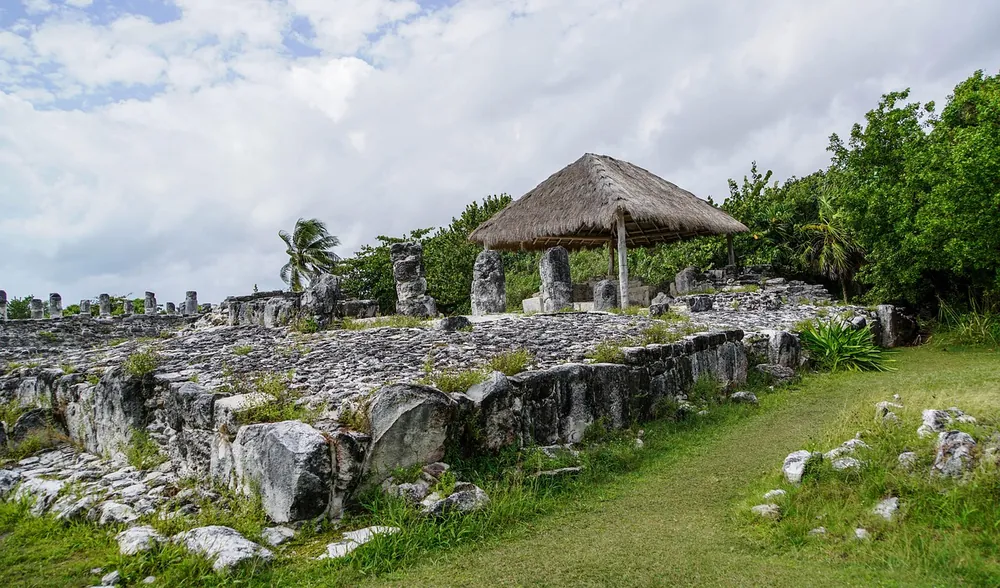
El Rey is a compact settlement of stone platforms, temple remains and columned spaces arranged along a main route with two small plazas. The appeal is in walking through the layout and noticing how the buildings relate to one another. This is not a visit built around one enormous pyramid.
Start with the main walkway and look across the plazas before concentrating on individual buildings. Low walls can be easy to dismiss at first glance, but they mark the footprint of a community that once lived and worked on this narrow strip of land. Read the interpretation as you go; it gives the stones a context that a quick photograph cannot.
Iguanas are another attraction for many visitors. If you spot them on the walls or beside the path, give them space and watch quietly. They are wild animals, not props for a close-up photograph. Do not feed, touch or chase them, and keep children from trying to pick them up.
A little El Rey history
El Rey’s most important period was the Late Postclassic, roughly the thirteenth to sixteenth centuries. Fishing and maritime trade helped sustain the coastal population. The nearby San Miguelito settlement was part of the same broader community, long before hotels lined Boulevard Kukulcan.
That connection is useful to keep in mind: these were inhabited coastal places, not isolated monuments built for visitors to admire. El Rey’s surviving ceremonial and public spaces show another side of Cancun’s past, beyond the modern resort city. Its visitor facilities were renovated before the archaeological zone reopened in July 2025.
Getting to El Rey
The entrance is at kilometre 18 on Boulevard Kukulcan in the southern Hotel Zone, near Playa Delfines. Use the archaeological entrance as your destination rather than just the beach name. From a nearby resort, a short taxi journey may be enough; from central Cancun or the northern Hotel Zone, allow more time.
A Hotel Zone bus can be a practical option. Before boarding, confirm that it continues towards El Rey or Playa Delfines and ask where to get off. For the return, check the direction you need rather than simply taking the first bus you see. There is no need to hire a car solely for this short visit.
If you are staying within walking distance, consider the heat and the road crossing as well as the distance. Use the available pedestrian crossings and be cautious around traffic. Combining the ruins with a look at Playa Delfines can work well, but leave beach equipment and a substantial picnic for the beach part of the outing.
Visiting El Meco ruins
What you will see
El Meco’s main landmark is El Castillo, a stepped pyramid about 12.5 metres high. It gives this small archaeological zone a different character from El Rey. Spend time looking at the pyramid from the plaza, then explore the surrounding structures along the permitted visitor route.
The relationship between the buildings and the coast is part of the interest here. El Meco was a port facing the waters around Isla Mujeres, rather than a large inland city. Its position helps explain why a relatively small settlement mattered in the coastal trading network.
The pyramid is a monument to appreciate from the visitor areas. Do not assume a photograph of someone on the steps means climbing is permitted today. Follow the current barriers and staff instructions, and keep off any structure that is closed to access.
A little El Meco history
El Meco developed from a fishing settlement into a trading centre. Archaeologists identify activity during the Late Classic period, around AD 600–800, and later growth during the Postclassic. Its location gave it an important role in maritime traffic and movement towards Isla Mujeres.
The present name is a later local name; the ancient name is not securely established. You may encounter proposed names or different starting dates in accounts of the ruins, but the central story is clear: this was a coastal community whose importance depended on its position beside the sea.
El Meco reopened in December 2024 after conservation and visitor-service improvements. The work included interpretation, paths, rest areas and facilities. Older reports saying it is closed for that renovation no longer describe its normal visiting status.
Getting to El Meco
El Meco is at kilometre 2.7 on the Puerto Juarez–Punta Sam road, north of Cancun on the mainland. It is not on Isla Mujeres, and you do not need a ferry to reach it. Be specific when arranging transport: ask for the El Meco archaeological zone, rather than a reef or another attraction with a similar name.
A taxi is a simple option for a short visit, particularly from accommodation along the northern mainland coast. Confirm the fare and arrange how you will return before setting off. From the Hotel Zone, the journey crosses the city, so include traffic and your hotel’s location in the plan.
Public transport also serves the area, but confirm the current Punta Sam-bound route, stopping point and return arrangements locally. Do not assume a bus that serves the Hotel Zone will continue to the ruins. If you drive, follow the entrance signs and use the designated parking area rather than stopping on the road.
Tickets and opening hours
Both archaeological zones are listed as open by INAH, Mexico’s National Institute of Anthropology and History. The normal schedules differ slightly, so keep the earlier El Meco closing time in mind if you plan an afternoon visit.
| Visit information | El Rey | El Meco |
|---|---|---|
| Opening days | Daily | Daily |
| Opening hours | 8am–5pm | 8am–4.30pm |
| Last entry | 4.30pm | 4pm |
| Foreign visitor | 145 pesos | 145 pesos |
| Mexican visitor or resident, Mon-Sat | 80 pesos | 80 pesos |
| Mexican visitor or resident, Sun | Free | Free |
These are the normal admission prices listed by INAH and checked on 12 October 2026. Each zone has its own admission; visiting one does not include the other. Arrive comfortably before last entry so you have time to enjoy the walk, rather than treating it as the start of a full hour’s visit.
Sunday admission is free for Mexican visitors and foreign residents of Mexico with supporting documentation. It is not a free-entry day for every overseas tourist. Foreign residents should bring their official residency documentation; a hotel booking or tourist stay is not proof of Mexican residence.
INAH also lists qualifying concessions, including children under 13, older adults, students and teachers, people with disabilities, retirees and pensioners. Bring the relevant identification or current credential and ask at the ticket desk before paying. INAH’s general public guidance describes these exemptions for Mexican visitors and foreign residents; overseas tourists should confirm eligibility rather than assume a foreign student or senior card guarantees free admission.
Practical advice for either visit
A short walk can still feel hot in Cancun. Aim for the opening part of the morning, carry water, wear a hat and choose comfortable shoes with grip. Sunscreen and insect repellent are useful; apply them away from the monuments and do not spray the stonework or wildlife.
INAH lists no smoking, no food and no pets at both zones. Plan meals outside the archaeological visit and follow the instructions at the entrance. Keep to the open paths, respect barriers and leave the stones where they are. Do not touch surviving decoration or use the ruins as a picnic seat.
Take ordinary holiday photographs from the permitted areas. If you want to bring professional equipment or arrange a commercial shoot, obtain the necessary permission before arriving. Do not assume a drone or tripod will be accepted simply because you have a ticket.
Uneven surfaces and outdoor paths matter if someone in your group has limited mobility. Ask the zone about the accessible route and facilities before travelling; a small archaeological area does not automatically mean a step-free visit. Give children time to stop, look at the buildings and watch any wildlife without rushing.
Other Maya outings from Cancun
Museo Maya de Cancún and the adjoining San Miguelito ruins offer another Hotel Zone option, combining museum collections with an archaeological walk. They are a separate visit from El Rey, with their own opening arrangements. Choose them if you want more interpretation and artefacts alongside the outdoor remains.
For monumental architecture and a longer excursion, consider Chichén Itzá, the coastal ruins at Tulum, woodland paths at Cobá or the distinctive buildings at Ek Balam. Our Cancun tours selection is useful if you would prefer an organised day out.
For El Rey and El Meco, the simpler outing is often the best one: pick the location that suits your stay, go before the strongest heat, and spend a little time imagining the coastal communities that existed here centuries before Cancun became a holiday destination.
References
- INAH — El Rey visitor information and archaeological interpretation.
- INAH — El Meco visitor information and archaeological interpretation.
- INAH — El Rey reopening announcement, July 2025.
- INAH — El Meco reopening announcement, December 2024.
- INAH — Archaeological-zone opening-status register and admission-concession guidance.