
Chichén Itzá: Visiting the Ancient Maya City
Chichén Itzá is the big one. Even if you have never visited Mexico, there is a fair chance you recognise its famous pyramid, El Castillo. Seeing it across the open plaza is a wonderful moment, but there is much more here than that one photograph: a vast ball court, carved platforms, columned halls and buildings that show how this powerful Maya city developed over centuries.
From Cancun, this is a full-day outing rather than a quick escape from the beach. Give the ruins a proper share of that day and arrive early if you can. If you are still choosing between ancient cities, our Mayan ruins near Cancun comparison is a useful starting point.
The featured early-start excursion offers an optional hotel-pickup arrangement. Select the pickup option suitable for your Cancun accommodation and budget for the separately listed government/admission charge. Early arrival does not guarantee entry before normal public opening.
What to see at Chichén Itzá
The principal monuments are spread across several connected groups. The area around El Castillo is the obvious starting point, but the southern buildings have a different character and deserve time too. You do not need to memorise every name before arriving; knowing what to look for makes the walk much more rewarding.
El Castillo, the Temple of Kukulcán
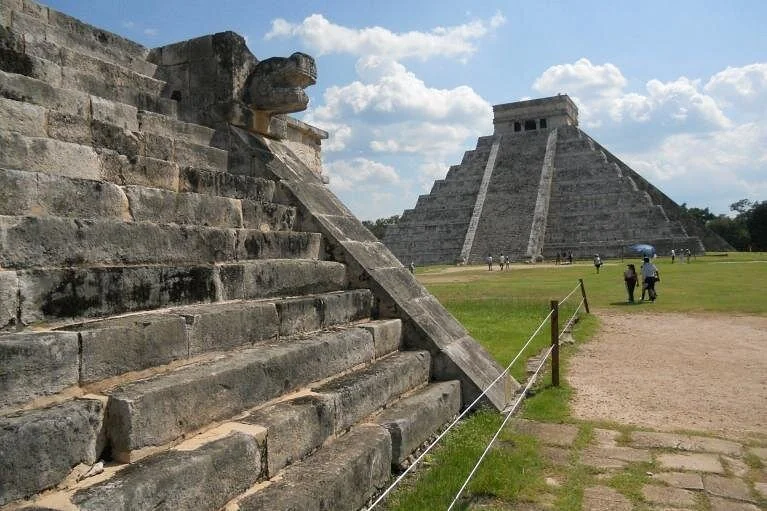
El Castillo is the great stepped pyramid at the heart of the visit. Its balanced shape makes it striking from almost every angle, so take a little time to walk around rather than stopping at the first clear photograph. Look for the stone serpent heads at the foot of the northern stairway.
Around the spring and autumn equinoxes, sunlight and shadow can create the appearance of a serpent along that stairway’s balustrade. The effect is associated with Kukulcán, the feathered serpent. It depends on sunlight and can be seen around the equinox period rather than at one guaranteed instant. A cloudy afternoon can disappoint anyone who has travelled specifically for it.
You cannot climb the pyramid or visit its interior on an ordinary tourist visit. That still leaves plenty to appreciate from ground level: the proportions, the stairways and its position within the wider ceremonial space.
The Great Ball Court
The scale of the Great Ball Court is impressive even after El Castillo. Walk along its sides and look up at the stone rings, then examine the carved panels at the base of the walls. This was a ceremonial setting as well as a place for a ball game, with imagery connecting play, power and sacrifice.
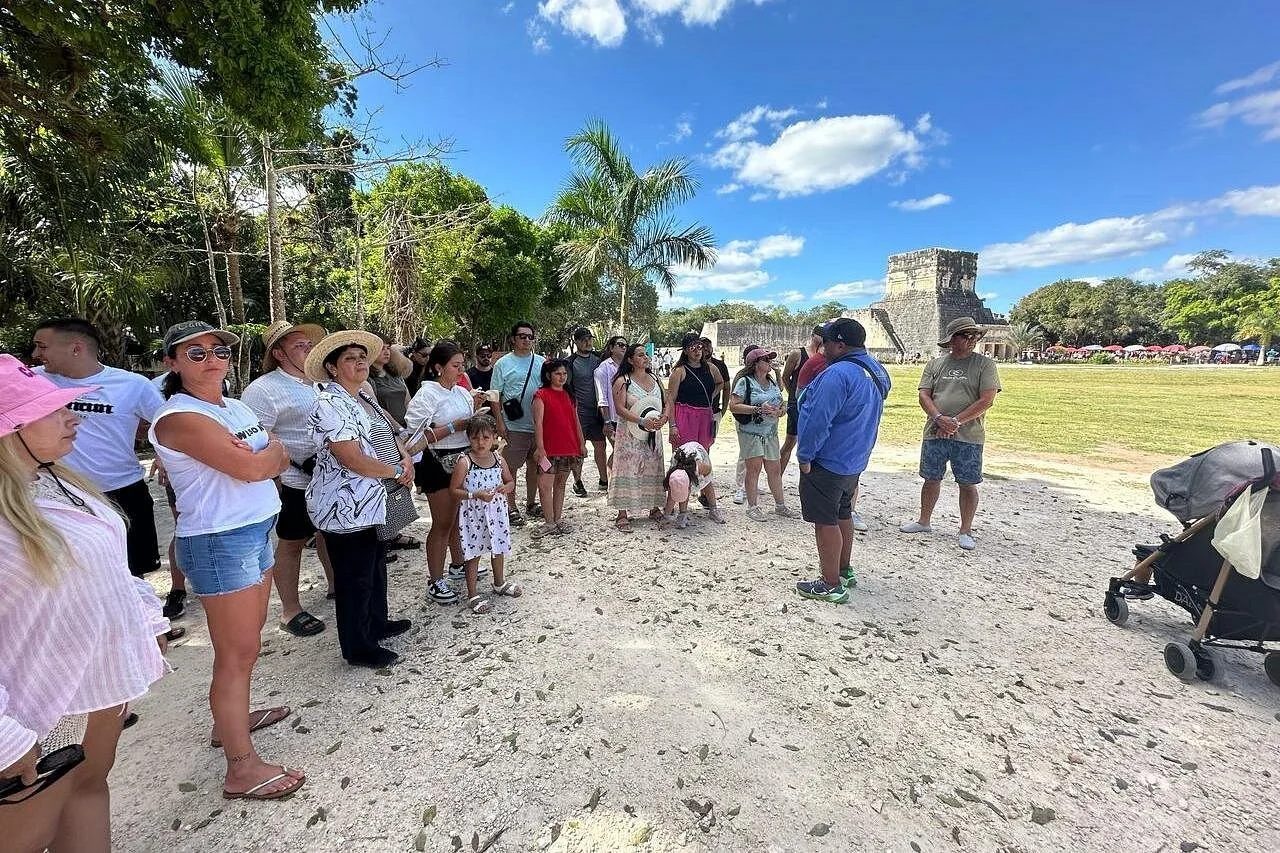
The surrounding temples are part of the experience, including the Temple of the Jaguars. A guide can help you pick out details that are easy to miss when everyone is moving towards the next landmark. Take familiar stories about exactly who was sacrificed after a match as interpretations rather than a simple rule applying to every ancient game.
The Temple of the Warriors and columned plazas
Across the main area, the Temple of the Warriors and the adjoining columns give a different impression of the city. El Castillo stands alone; here the repeated pillars suggest extensive gathering spaces and roofs that have long disappeared. Look along the rows as well as towards the temple.
The nearby platforms reward a slower look. Serpents, skulls, eagles and jaguars occur in the stone decoration. These are more than attractive motifs: they help convey the religious and military character of this part of Chichén Itzá.
El Caracol, Las Monjas and the southern buildings
El Caracol is the round building often called the Observatory. Its name refers to the spiral staircase inside, while its form and orientation have prompted astronomical interpretations. You see the exterior from the permitted paths, rather than entering a working observatory.
Las Monjas and the adjoining La Iglesia are particularly good places to notice elaborate façade decoration and rain-god masks. The Spanish names, meaning the Nunnery and the Church, describe what the buildings reminded later visitors of; they were not Christian religious buildings. Their architecture contrasts with the great northern plaza.
The Sacred Cenote
A sacbé, or ancient raised road, leads north from the main plaza towards the Sacred Cenote. This natural sinkhole was an important place of offerings and ritual, including human sacrifice. Its significance lies in that history and its relationship with the city, rather than in sparkling swimming water.
Visit it as an archaeological feature and stay within the permitted viewing area. It is not the cenote swim advertised on day tours; those stops take place at separate attractions outside the ruins.
A little Chichén Itzá history
Chichén Itzá developed over several centuries, with settlement established by around the sixth century AD. Its greatest political and architectural importance extended through the Late and Terminal Classic periods and into the Early Postclassic, broadly around AD 800–1200. Those dates help explain why the buildings do not all look alike.
The southern groups include architecture associated with the Puuc and Chenes traditions of the Maya region. The great northern monuments show connections with central Mexico, often described as Maya-Toltec influences. The precise relationships between peoples, rulers and styles are more complicated than a single invasion story.
Cenotes mattered in a landscape without the surface rivers you might expect elsewhere. They provided access to water and could also be sacred places. The city’s name is commonly translated as a reference to the mouth or edge of the well of the Itzá.
Chichén Itzá’s power declined, but its ceremonial importance outlasted its position as a leading city. Nor did Maya people disappear when the great buildings ceased to be centres of government. Maya communities, languages and traditions remain part of life across the peninsula today. UNESCO added Chichén Itzá to the World Heritage List in 1988.
Tickets and opening hours
The recently updated INAH listing gives daily opening hours of 8am–5pm, with last entry at 4pm and clearing beginning at 4.30pm. Older official summaries show earlier closing or entry times. An early visit avoids that uncertainty and gives you enough time to see the main groups properly; 4pm is a last-entry limit, not a sensible arrival target.
Admission combines a federal INAH charge and a Yucatán state charge. The published combined-ticket figures checked for this update are:
| Visitor category | Federal charge | State charge | Combined total |
|---|---|---|---|
| Foreign visitor | 105 pesos | 592 pesos | 697 pesos |
| Mexican visitor or resident, Mon-Sat | 105 pesos | 205 pesos | 310 pesos |
| Mexican visitor or resident, Sun | Free | Free | Free |
Carry official identification if claiming a Mexican, resident or concession rate. Federal exemptions and state concessions have their own conditions: a federal exemption does not automatically mean every part of a visit costs nothing. Sunday entry is free for Mexican citizens and foreign residents of Mexico who present proof of nationality or residency. Ordinary foreign tourists still pay the standard foreign-visitor charge. Check the applicable category at the official ticket desk.
INAH’s latest notice directs visitors to the ticket desks at the visitor centre. Buy through the official arrangement and keep your ticket. Parking, a guide, meals and a separate cenote visit are additional costs unless explicitly included in something you have booked. A tour price is not proof that archaeological admission is covered.
The Gran Museo and Chichén Viejo, also called the Grupo de la Serie Inicial, need their own planning. Chichén Viejo has controlled visits and advance-reservation arrangements, so do not simply add it to an ordinary walking route. Special equinox operations can close both attractions. The evening Noches de Kukulcán presentation is also a separate experience, not part of normal daytime admission.
Getting to Chichén Itzá from Cancun
Chichén Itzá is inland in Yucatán, near Pisté and west of Valladolid. For a Cancun stay, allow roughly three hours each way by car as a planning estimate, with more time possible from a distant hotel or during delays. The travel is the main reason I would keep the rest of the day fairly simple.
Driving yourself
The toll road towards Valladolid is the usual faster approach from Cancun; the free-road alternative adds towns and generally takes longer. Follow the current signs for Chichén Itzá and the official visitor entrance rather than relying on an old parking pin. Access arrangements have changed, and the visitor centre now plays an important role in arrival and ticketing.
Allow time for parking, tickets and the onward approach to the monuments. Budget separately for tolls, fuel, rental insurance and parking. Download the route before leaving, start with enough fuel and decide who will drive home after several hours of walking in the heat. An overnight stay in Valladolid makes an early visit much less demanding.
Bus or Tren Maya
Independent public transport can work, but plan the return journey before buying the outward ticket. Check the current bus timetable for your date and whether the service goes to Chichén Itzá itself or requires a connection in Valladolid. A departure that looks convenient may leave you with too little time at the ruins.
The Tren Maya has a Chichén Itzá station. Include the journey to Cancun’s station, the onward connection to the visitor entrance and the return connection in your calculation. A station bearing the attraction’s name does not mean you step directly off the train beside El Castillo. Compare the complete trip, rather than the train ride alone.
Watch the time-zone change
Yucatán is one hour behind Cancun. When it is 9am in Cancun, it is 8am at Chichén Itzá. Opening times here use Yucatán time; your Cancun hotel pickup uses the departure arrangements in your booking. Phones may change automatically as you travel, so check which local time a return ticket or meeting time uses.
A good visiting route
I would allow around three hours for the main archaeological visit, then add time for arrival and any museum or reserved extra. A shorter guided stop can show the best-known monuments, but it is a different experience from having time to wander through both the northern and southern groups.
- Start with El Castillo: get your bearings and enjoy the main plaza before moving straight into photographs.
- Visit the Great Ball Court and nearby platforms: look closely at the carvings as well as the scale of the buildings.
- Continue towards the Temple of the Warriors and columns: this helps build a picture of the city’s larger public spaces.
- Add the Sacred Cenote: make the out-and-back walk while you still have the energy and time.
- Explore the southern groups: give El Caracol, Las Monjas and La Iglesia a proper look before returning towards the exit.
Treat that as a useful sequence, not a promise that every path will be open or that every arrival enters from the same direction. Follow the current visitor route and adjust to your entrance, guide and any cordons. If you need a shorter visit, prioritise a few monuments rather than rushing every group.
Heat, crowds and visiting rules
Chichén Itzá is much more exposed than a shaded jungle walk. Arrive near opening, bring water, wear a hat and comfortable secure footwear, and take breaks before you feel worn out. The sea breeze at your Cancun hotel is a poor indication of how the inland afternoon will feel.
Pack lightly and check current bag restrictions before travel. Use the toilets before heading well into the ruins. Some paths are uneven, and accessible services do not make every part of an ancient city equally easy to reach. Anyone with limited walking stamina will get more from a realistic shorter route than from trying to keep pace with an ambitious group.
Stay behind barriers and do not climb monuments, touch carvings or enter restricted buildings. Professional photography, tripods and drones require the relevant INAH permission; an ordinary admission ticket does not provide it. Follow the instructions at the entrance, including restrictions on smoking, alcohol and prohibited items.
You will encounter souvenir sellers during the visit. A polite “no gracias” is enough if you are not interested. Agree a price before buying and keep your main attention on the archaeology. Equinox visits bring particularly large crowds; choose a normal early morning if a quieter walk matters more to you than the serpent-shadow event.
Adding a cenote or Valladolid
A cenote swim can be a lovely change after walking around the ruins, provided it fits comfortably into your day. The Sacred Cenote inside Chichén Itzá is not a swimming stop. Choose a separately operated cenote with clear visitor facilities, permitted swimming and a practical route back towards your accommodation.
Check the entrance charge, changing facilities, steps and life-jacket rules before committing. Allow for changing and drying off as well as time in the water. Deep water and slippery access deserve respect; use the required flotation equipment and skip jumps or activities beyond your ability. You can enjoy a cenote without treating the swim as compulsory.
Valladolid is a sensible place for a meal and a walk around the centre, or an overnight base before an early ruins visit. Trying to fit Chichén Itzá, a long swim, a leisurely Valladolid afternoon and another major archaeological site into a Cancun day trip usually means compromising somewhere. One worthwhile extra is often enough.
Chichen Itza tours from Cancun
An organised excursion takes care of the long drive and can add the explanation that makes the monuments more meaningful. For many Cancun visitors, that is the easiest way to visit. Choose an itinerary that gives Chichén Itzá enough time rather than judging the day by the number of stops.
Check the actual Cancun pickup or meeting point, admission arrangements and expected time inside the ruins. “Early access” may mean reaching the normal opening time rather than entering before public hours. A private trip offers more control; a shared excursion usually costs less per person but follows a fixed timetable.
Our Chichen Itza tours from Cancun comparison covers the different formats, pickup arrangements and cenote combinations in more detail. You can also explore our Cancun tours for other days out. If you prefer a different archaeological setting, consider the forest paths at Cobá or the coastal views at Tulum.
References
- INAH: Chichén Itzá visitor information, monument descriptions and current access notices.
- Patronato CULTUR: Yucatán visitor-service charges and Chichén Itzá ticket information.
- UNESCO World Heritage Centre: historical context and World Heritage inscription.
- Centro Nacional de Metrología: Mexico’s official time zones.
- Tren Maya: station and route information for independent travel.