
Cancun Sargassum
Sargassum can turn a beautiful Cancun beach into a very different place. A few strands at the water’s edge are one thing. Thick brown water, piles of seaweed and the smell of rotting algae are another. If swimming in the Caribbean is a big part of your vacation, it deserves some attention before you book.
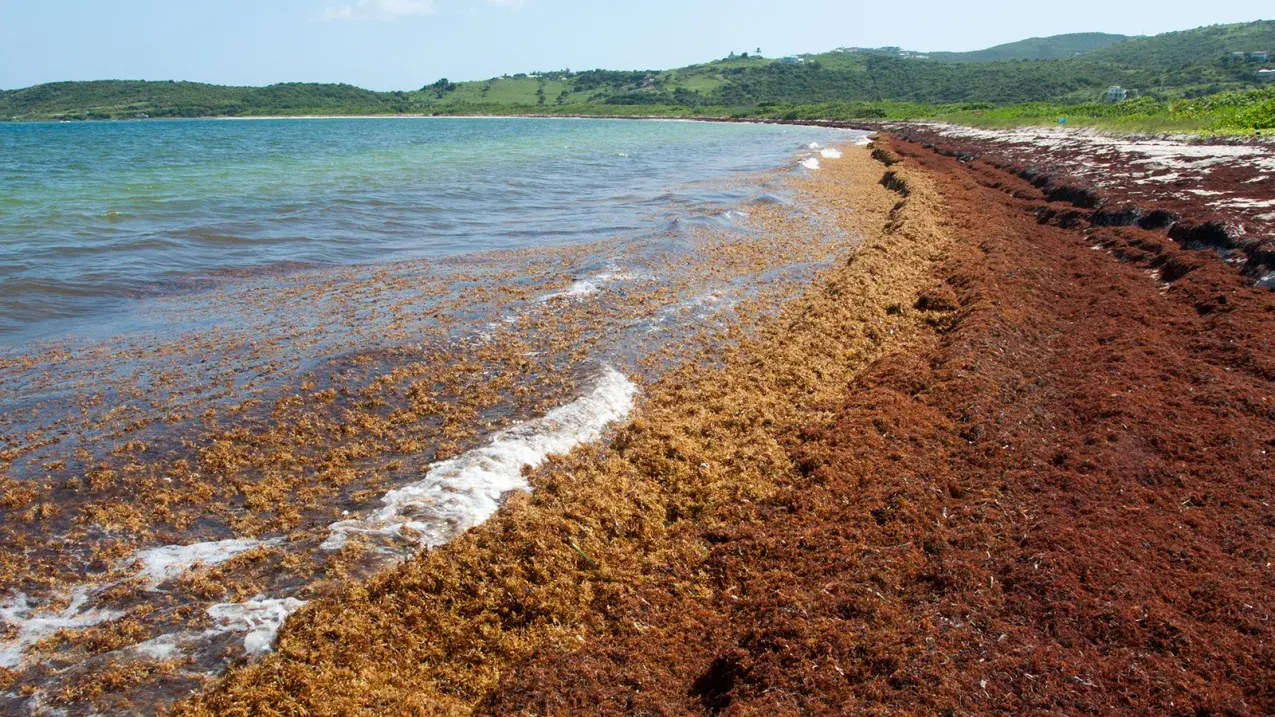
The useful questions are when it is more likely, which coast your hotel faces and what the actual beach looks like close to your trip. A dramatic photograph from somewhere in the Caribbean does not answer those questions. Neither does an ocean-wide figure measured in millions of tons.
At a glance
- What it is: floating brown seaweed, usually called sargazo in Mexico.
- When to expect more: spring and summer are the main planning concern, although arrivals can happen outside that period.
- Where to compare: Cancun’s north-facing bay beaches and the open Caribbean coast can have very different conditions.
- What to check: recent, dated views of your particular beach, followed by local flags and advice when you arrive.
- Latest regional context: September 2026’s USF outlook reported an overall seasonal decline, but the western Caribbean had not declined from August.
- For swimming: avoid thick accumulations and decomposing piles; choose another stretch or another activity.
When is seaweed season in Cancun?
Spring and summer are the main period to consider when planning around sargassum. Across the tropical Atlantic, blooms commonly grow through the first part of the year and become large in late spring and summer before declining later. Beach arrivals lag, overlap and vary locally, so an offshore peak and a hotel beach’s worst week need not coincide.
For booking purposes, treat roughly April through October as a period requiring particular attention. This is a broad planning window, not an official opening and closing date. Early arrivals occur, and an autumn decline can leave plenty of material available for another beaching event.
Late autumn and winter generally offer better odds of avoiding the largest seasonal accumulations, but there is no guaranteed seaweed-free month. In January 2026, USF was already reporting beaching in parts of the western Caribbean, including the Mexican Caribbean coast.
A fixed calendar showing every winter month as clear and every summer month as bad would be misleading. The choice is about probability, the beach you choose and your flexibility. If you also want to compare rain, temperature and winter cold fronts, use our Cancun weather guide.
Which Cancun beaches are less affected?
Cancun’s Hotel Zone bends like a number 7. The north-facing arm looks towards Bahía de Mujeres; the long eastern arm faces the open Caribbean. That difference is more useful than choosing a hotel simply because its address says Cancun.
North-facing bay beaches are worth comparing when the open Caribbean coast has heavy arrivals. Beaches such as Las Perlas, Langosta and Tortugas sit on that bay-facing side. Their exposure differs from the long open-coast stretch running south from Punta Cancun towards Punta Nizuc, where Playa Delfines is located.
Less exposed does not mean immune. Wind changes can bring seaweed into sheltered water, and accumulation can vary between neighbouring properties. Beach shape, nearby structures and cleanup all affect what you actually see. Our Cancun beaches guide explains the main public beaches, access points and swimming considerations.
What about Isla Mujeres?
Isla Mujeres gives you a different coastline to compare. Playa Norte and the island’s western side have a different exposure from its eastern shore, so they can be useful alternatives when Cancun’s open coast is affected. Do not assume that a clean photograph of Playa Norte represents every beach on the island.
Check a recent view before paying for the ferry or committing your whole day. Our Isla Mujeres guide covers the island itself, and Getting Around Cancun explains the different ferry departure settings and local transport choices.
Playa del Carmen, Puerto Morelos and Tulum are also on the Mexican Caribbean. Moving south is not automatically an escape from a regional arrival. Choose a specific beach with recent evidence rather than assuming a different resort town will solve the problem.
How to check current sargassum conditions
Start with a named beach and a date. A useful update identifies the stretch of coast, shows the shoreline and water, and says when it was taken. An undated aerial picture, a recycled video or a general label such as Riviera Maya is much less helpful.
- Find the exact beach. Establish which coast your hotel faces and where the camera or photograph is positioned.
- Check the timestamp. Make sure a webcam is actually live and that a recent-looking video was not filmed during a previous season.
- Look at water as well as sand. A freshly cleaned beach can have another mat approaching, while a thin strandline may sit beside clear swimming water.
- Compare nearby views. A wide coastline needs more than one camera, especially if you are considering another beach.
- Check again after arrival. Follow lifeguards, flags, closures and the conditions in front of you.
Our Cancun webcams provide views of selected locations. A camera cannot show everything: the frame may miss the shoreline, distance can hide floating strands, and it cannot establish water quality or the strength of a smell.
USF’s Sargassum Watch System and NOAA’s monitoring tools help put local observations into regional context. Satellite observations and models can indicate where floating material is present and where arrivals may be possible. They cannot establish what one hotel beach will look like on a particular vacation date.
The latest regional outlook: September 2026
The latest completed monthly USF bulletin available when this article was checked was dated 30 September 2026. It reported a continuing overall decline across the belt as the season progressed. The western Caribbean, however, remained unchanged from August. That distinction matters for a destination on the western side of the Caribbean.
The outlook expected further reductions into possibly November, with beaching still occurring around the Caribbean. This is regional background from September’s observations, not a report that Cancun’s beaches are clear on 19 October. For a trip arriving soon, move from the regional picture to recent views of your chosen beach.
Can you swim with sargassum, and is the smell dangerous?
A few drifting strands do not mean the entire sea is unsafe. Dense accumulations are a reason to swim somewhere else. They can hide obstacles and organisms, make entry unpleasant and interfere with a clear view of the water. A lifeguard’s warning still applies even if a different beach looks inviting online.
The algae itself does not sting, but small creatures living among it can irritate skin. Florida’s Department of Health advises avoiding touching or swimming near the seaweed. Keep children from playing in piles, and do not treat floating mats as something to push through to reach clear water.
Why does it smell like rotten eggs?
When large stranded accumulations decompose, microbial breakdown can release hydrogen sulfide, the gas associated with the rotten-egg smell. Ammonia can also be released. This is a problem associated with decay, rather than healthy floating seaweed automatically emitting the same gases everywhere.
Exposure can irritate the eyes and airways, and people with asthma or other respiratory conditions can be more sensitive. The practical response to irritation, headache, nausea or breathing discomfort near rotting piles is to move away into fresh air. Seek medical help for significant or persistent symptoms, and urgent help for difficulty breathing.
Smell alone cannot measure exposure or establish that a place is safe. Avoid lingering beside thick rotting deposits or enclosed storage areas, and give cleanup operations room to work. Hotel guests should not dig into large accumulations or join an improvised cleanup without proper arrangements.
Do not eat beach-collected seaweed
Sargassum can accumulate arsenic and other contaminants. That is a separate issue from gases produced during decomposition. It is one reason health authorities advise against using collected sargassum in cooking, and why proposed food, cosmetic or agricultural uses require testing and processing. A natural origin does not make material picked up from the beach suitable to eat.
What are Cancun and the Mexican Caribbean doing about it?
The response combines offshore monitoring, interception near the coast, collection vessels, beach crews and disposal. Authorities and hotels have different roles, and results vary with the volume arriving and the weather. A cleared beach represents work completed at that location, rather than proof that the regional bloom has ended.
On 30 July 2026, Mexico’s presidency announced 2 billion Mexican pesos for the regional sargassum strategy, identifying additional collection boats, barriers and beach equipment. Cancun, Playa del Carmen, Puerto Morelos, Tulum and Mahahual were named. That was a funding and capacity announcement, not confirmation that every planned measure had been delivered or that every hotel beach would remain clear.
Why barriers cannot guarantee a clear beach
Floating barriers aim to intercept or redirect seaweed before it reaches the sand, allowing collection in a more manageable area. Their effectiveness depends on positioning, operation, sea conditions and the material arriving. They are part of a system that needs collection and maintenance, rather than a permanent lid on the sea.
Operations must also take account of boats and wildlife. The algae may contain young turtles, fish and other animals, so removing it is more complicated than scooping floating litter out of an empty pool. Strong weather can restrict work precisely when visitors would most like an immediate solution.
Removing it without removing the beach
Heavy machinery can collect sand along with seaweed and damage the coastal environment. Good practice aims to minimize sand loss, avoid wildlife disturbance and remove large fresh accumulations before prolonged decay. The objective is not to strip every natural strand from a beach at any cost.
Disposal matters too. Large piles can release gases and contaminated liquid as they break down. Dumping material out of sight does not make those effects disappear. The US Environmental Protection Agency highlights the need to protect nearby people, soil and water when selecting storage, treatment and disposal arrangements.
Researchers and businesses are investigating uses such as construction materials, energy and processed agricultural products. Turning a variable, salty, wet and potentially contaminated material into a reliable product takes more than finding a possible use. Testing, transport and treatment remain part of the job.
How much should it affect your trip?
If your ideal vacation is swimming in the sea outside your room every day, give beach exposure and seasonal timing real weight when choosing a hotel. Compare the north-facing bay with the open coast, inspect recent conditions and check the hotel’s written terms before buying a booking you cannot easily change.
If you mainly want a good resort, pools, restaurants and a mixture of days out, a period of seaweed may matter less. That is a personal choice. There is no need to dismiss a genuine beach concern, but a regional headline alone is a poor reason to conclude that every Cancun vacation is ruined.
Build in a couple of alternatives. A different public beach may be enough; on another day, cenotes, ruins, shopping or a pool day may make more sense. Cenotes are inland freshwater settings, although each has its own access, swimming and safety rules. Check the journey before setting out, especially if it involves a ferry or a long transfer.
Make the decision using the beach you will actually use, not the name of the whole region. Keep checking close to travel, and leave some room to adjust once you are here.
What is sargassum?
Sargassum is a group of brown algae. The drifting seaweed responsible for the big Atlantic and Caribbean arrivals mainly consists of two species, Sargassum natans and Sargassum fluitans. Their small, berry-like floats help keep the branching fronds near the surface, where they receive sunlight.
These free-floating forms spend their lives at sea. They do not need to attach to a rock or the seabed, and they can reproduce by fragmentation: a piece breaks away and continues growing. The brown clumps arriving in Cancun have generally drifted in, rather than being torn out of a local underwater meadow.
That distinguishes them from seagrass, which is a flowering plant rooted in the seabed, and from seaweeds attached to rocks. A beach can receive a mixture of natural material, so every brown strand on the sand is not necessarily part of a major sargassum event.
A floating habitat, not simply rubbish
Out at sea, sargassum is valuable habitat. Small fish, shrimp and crabs shelter among its branches. Young sea turtles use the floating cover, and larger animals feed around the rafts. NOAA describes these communities as providing food, shelter and breeding habitat for hundreds of marine species.
A modest natural strandline also belongs on a living beach. The problem comes when huge quantities collect in shallow water or wash ashore faster than the coast can cope with them. Dense masses block light, obstruct wildlife and eventually decompose. What supports life offshore can overwhelm a small coastal area when concentrated in the wrong place.
Why has sargassum become such a problem?
The seaweed itself is not new. The major change is the large population now growing across the tropical Atlantic, much farther south than its best-known historical home in the Sargasso Sea. Since 2011, this population has produced repeated large arrivals across the Caribbean and along parts of West Africa.
Scientists call it the Great Atlantic Sargassum Belt. In major years, scattered rafts span an enormous distance between West Africa and the Gulf of Mexico. The belt has been reported at approximately 8,850 kilometers long, or about 5,500 miles. It is a broad region containing drifting patches, not an unbroken carpet you could walk across.
There are three different questions behind the headlines: how the seaweed reached this region, what sustains its growth, and what sends it onto a particular beach. They have related but different answers.
Winds and currents helped establish the new population
Research has linked the initial shift to unusual North Atlantic winds and circulation during 2009 and 2010. The proposed route moved a seed population out of the subtropical North Atlantic into tropical waters, where conditions allowed it to persist and bloom.
A 2025 study in Communications Earth & Environment tested this explanation using simulations covering 2002 to 2022. Its findings supported the importance of that circulation anomaly and of nutrients brought towards the surface by vertical mixing. This helps explain why the change is dated to around 2011 rather than described as seaweed appearing from nowhere.
Nutrients feed the growth, but their sources matter
Like other algae, sargassum needs sunlight and nutrients, including nitrogen and phosphorus. River discharge, ocean mixing, upwelling, atmospheric inputs and biological recycling can all contribute nutrients. Their importance varies with location and time.
A 2021 Nature Communications study compared seaweed tissue collected across the Atlantic basin between 1983 and 2019. The researchers reported 35% more nitrogen in the later samples than in the 1980s baseline. That is evidence of a change in the seaweed’s nutrient supply. It does not mean Cancun’s seaweed increased by 35%, or that a particular river caused every bloom.
More recent work has put greater emphasis on ocean processes. A 2025 Nature Geoscience study linked phosphorus supplied by equatorial upwelling with nitrogen fixation, a process in which certain microorganisms convert nitrogen gas into a form living things can use. The researchers argued that this combination could explain much of the variability since 2011.
An April 2026 Nature Communications study highlighted another mechanism: nutrients recycled by the community living with the seaweed and by older mats. Its model suggested that this contribution has become increasingly important in sustaining the large population. Think of the raft as an ecosystem with its own recycling, rather than a plant waiting only for fertilizer to arrive from shore.
It is too simple to blame one thing
Runoff and nutrient pollution matter, and reducing them remains worthwhile. But the often-repeated explanation that Amazon fertilizer alone caused Cancun’s sargassum problem goes further than the evidence supports. Recent studies differ over the relative roles of rivers, mixing, upwelling and recycling.
Climate matters too. Temperature affects growth and decay, while winds, currents and mixing affect both transport and nutrient supply. That does not establish a simple rule that each hotter year must produce more seaweed on Cancun’s beaches. The causes of the basin-wide population and the details of a local arrival still require several processes to be considered together.
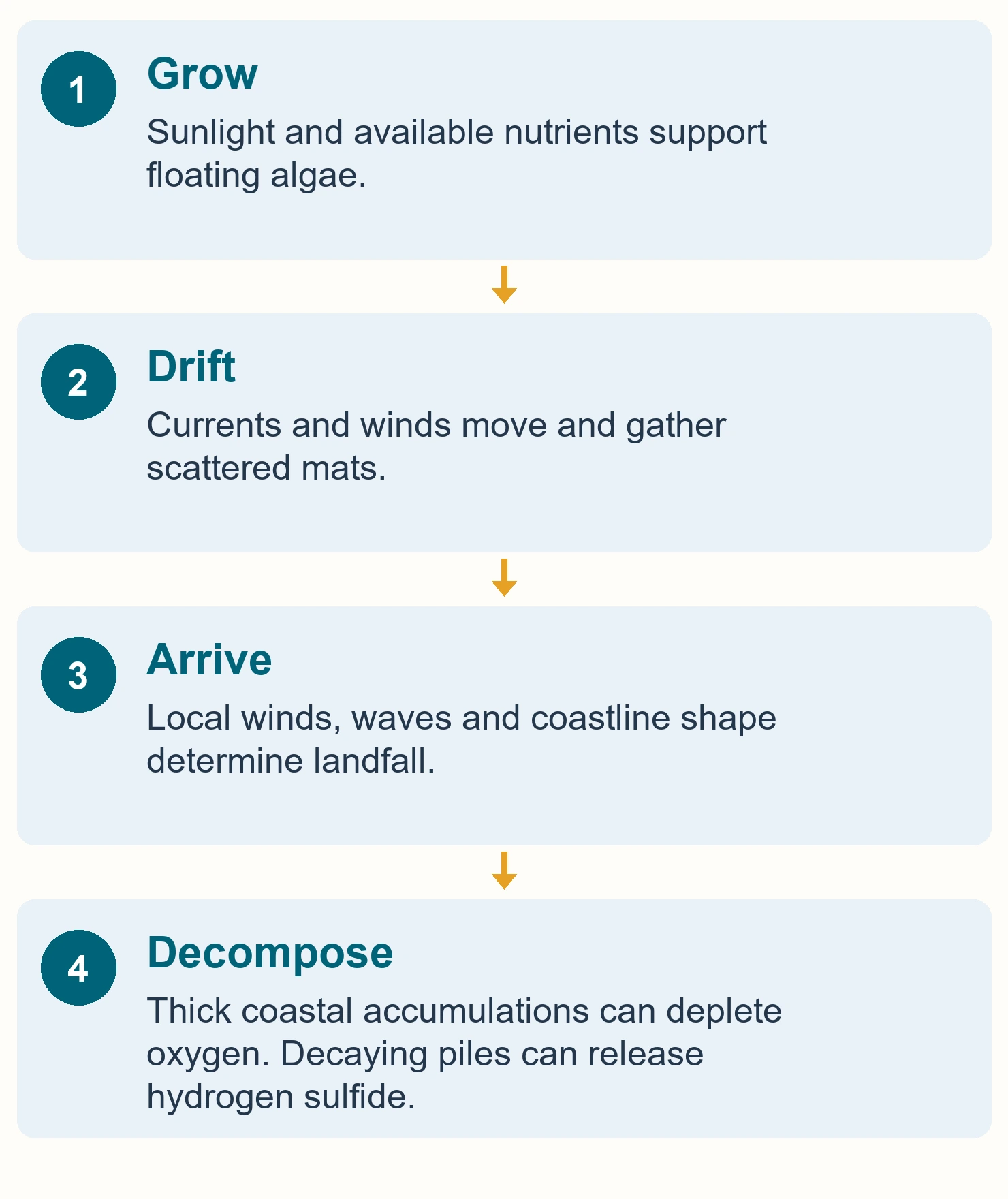
Once the seaweed is in the Caribbean, currents move it around and winds help gather or spread the mats. Near Cancun, the final approach depends on local winds, waves and coastal shape. A large regional bloom creates the potential for trouble; it does not distribute that trouble evenly along every beach.
What the big sargassum numbers mean
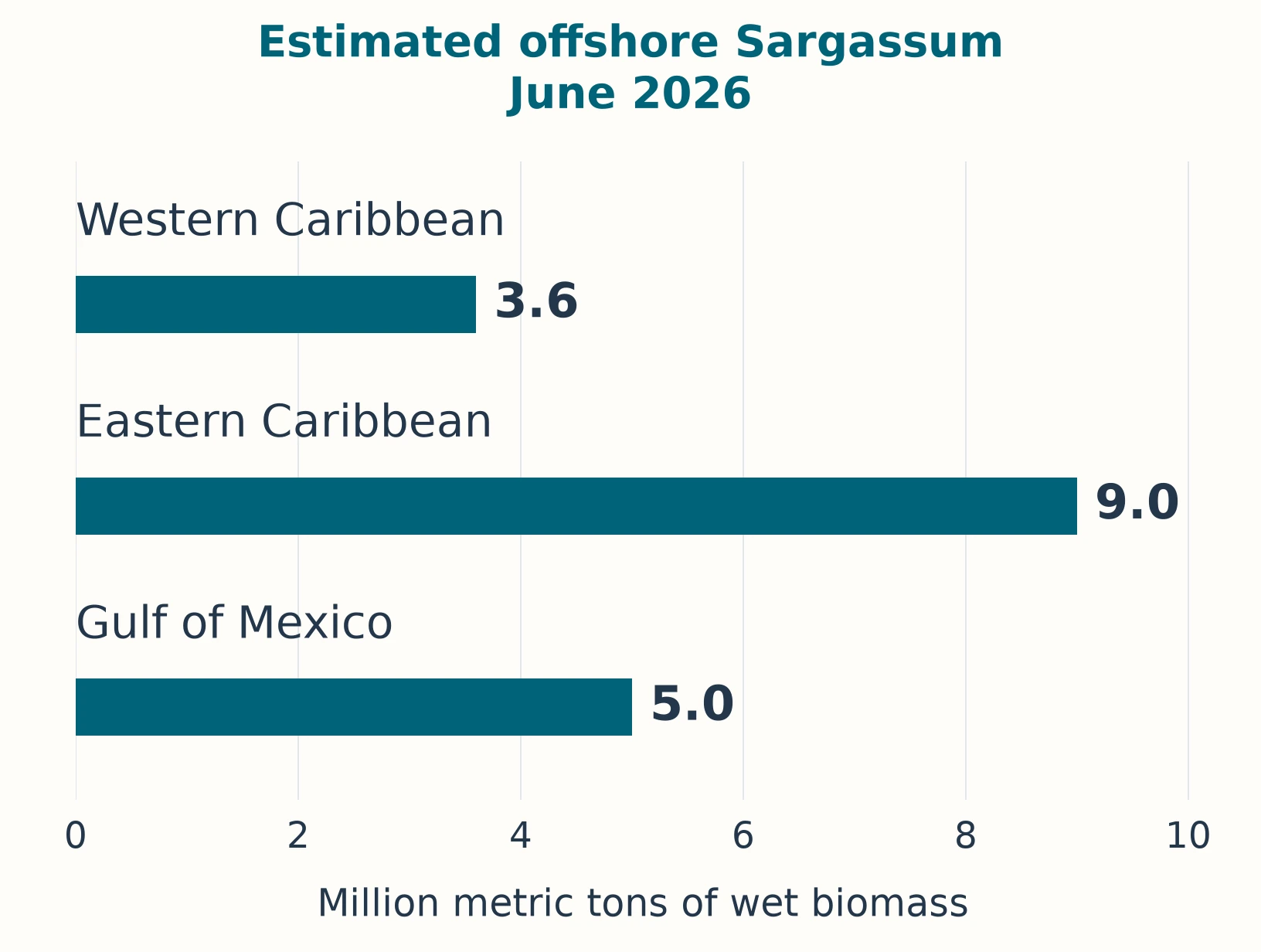
The scale is substantial. Research estimated more than 20 million metric tons of wet sargassum in the Great Atlantic Sargassum Belt in June 2018. That figure describes material estimated to be present across a huge ocean region during a particular month. It is not the amount collected in Cancun, and it is not a year’s total production.
For June 2026, NASA reported estimates of 3.6 million metric tons in the western Caribbean, 9 million in the eastern Caribbean and 5 million in the Gulf of Mexico, drawing on USF observations. Cancun lies in the western Caribbean, on Mexico’s Caribbean coast. Those are three regional offshore estimates for the same month. A basin estimate cannot tell you whether the water outside your hotel is clear this morning.
| Number you see | What it measures | What it does not tell you |
|---|---|---|
| Monthly offshore biomass | Estimated wet weight present in a defined ocean region. | How much will reach Cancun or a particular hotel. |
| Satellite surface coverage | The fraction of an observed area covered by floating algae. | A solid wall of seaweed across the whole coloured area. |
| Beach collection totals | Material removed over a stated period and area. | The remaining offshore amount or an equal impact at every beach. |
| A beach photograph | The visible conditions at one place and time. | Conditions everywhere in Cancun or throughout your vacation. |
Wet weight includes the water in the material, so it should not be compared directly with dry-weight figures. Collection statistics also depend on the period, coastline covered and measurement method. Adding successive monthly offshore estimates together would count some of the same surviving seaweed repeatedly.
Common questions about Cancun sargassum
Does every Cancun beach get sargassum at the same time?
No. Coast orientation and local conditions make a difference. One stretch can be heavily affected while another is more usable. Compare named beaches and recent views rather than applying one photograph to all of Cancun.
Is there a hotel with a guaranteed seaweed-free beach?
A hotel can have a less exposed setting and a strong cleanup operation, but neither controls all incoming seaweed. Treat absolute claims cautiously and distinguish clean sand from clear water. A good pool is a useful fallback if sea swimming is affected.
How long does a bad spell last?
There is no fixed number of days. Conditions can improve when transport changes and crews remove stranded material, or repeated arrivals can prolong the problem. A beach’s appearance yesterday cannot establish how it will look throughout next week.
Is sargassum the same as red tide or sea lice?
No. Sargassum is visible brown macroalgae. Red tide refers to particular microscopic algal blooms, while the swimmer’s rash commonly called sea lice involves tiny marine organisms. Several different things can affect swimming conditions, so identifying one does not rule out the others.
Should I wait for a long-range forecast before booking?
Use seasonal patterns to choose the kind of trip and beach that suit you, then use recent local evidence nearer departure. Regional forecasts can improve planning, but they cannot remove the uncertainty of a specific beach months ahead.
Visitor information references
University of South Florida Optical Oceanography Laboratory’s monthly outlooks; NOAA’s explanations of floating habitat and transport; NASA Earth Observatory’s June 2026 regional measurements; peer-reviewed research published in Nature Communications, Nature Geoscience and Communications Earth & Environment; and US EPA and Florida Department of Health guidance on coastal impacts, handling and exposure.