
Mexican Currency and Banknotes: What Pesos Look Like
Mexican currency is called the peso. Its currency code is MXN, its symbol is $, and one peso is divided into 100 centavos.
The $ sign is used by many currencies around the world and should not be assumed to mean US dollars. In Cancun, a price shown only with $ means Mexican pesos. Prices in US dollars are marked USD; MXN may be used to label peso prices explicitly. Pay in the currency quoted. That avoids having the vendor convert the price using a rate they decide. The exchange rates vendors use for these conversions are unregulated, so each vendor can choose the rate it applies. See our Cancun currency guide for the fuller pesos-versus-dollars explanation.
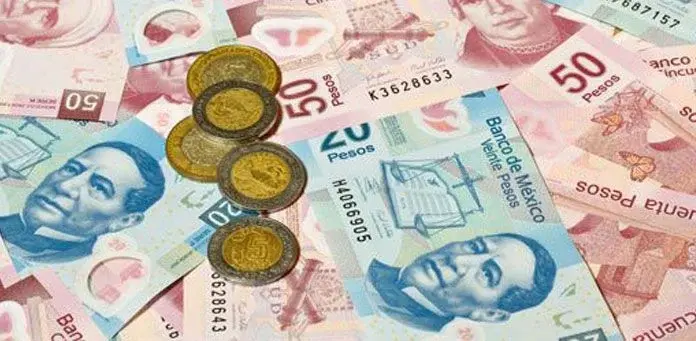
The current Mexican banknotes are colorful and easy to tell apart once you know what to look for. Small notes are worth guarding with your life—well, almost. Nobody ever seems to have change, and you will often be asked for the odd peso or two to round a total up or down. It can feel like a competition to see who can break the larger notes and hoard the most small ones. Join in; they will come in useful.
Key Takeaways
- Mexico’s currency is the peso, coded MXN and shown with the
$symbol. - In Cancun, an unqualified
$price means pesos; US-dollar prices are markedUSD. - Current Family G banknotes come in 20, 50, 100, 200, 500 and 1,000 pesos.
- Keep smaller notes for ordinary spending because a 1,000-peso note can be awkward to use.
Mexican peso banknotes currently in use
Banco de México currently manufactures Family G banknotes in six denominations: 20, 50, 100, 200, 500 and 1,000 pesos. These are Mexico’s current designs, but older designs may also remain valid and in circulation.
The 20-, 50- and 100-peso notes are polymer, with transparent windows. The 200-, 500- and 1,000-peso notes are cotton paper. Each denomination is a different length, so higher-value notes get progressively longer.
20-peso banknote
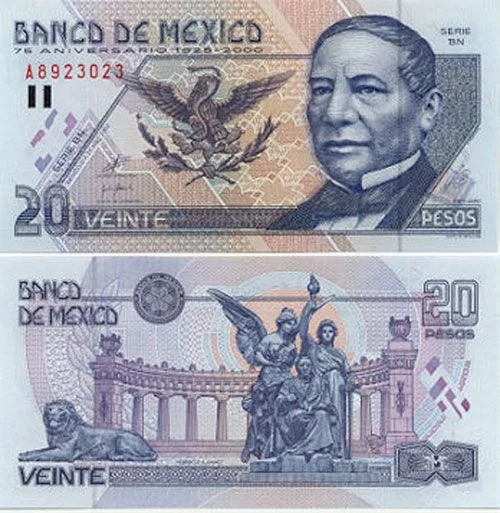
Look for: a horizontal red-and-green polymer note. The front shows the entry of the Army of the Three Guarantees into Mexico City in 1821. The reverse shows Sian Ka’an in Quintana Roo, with mangroves, a Mexican crocodile and a chocolate heron.
This is the current Family G commemorative 20-peso note. Do not confuse it with the older blue polymer 20-peso note featuring Benito Juárez, which is being withdrawn gradually but still keeps its 20-peso value.
50-peso banknote
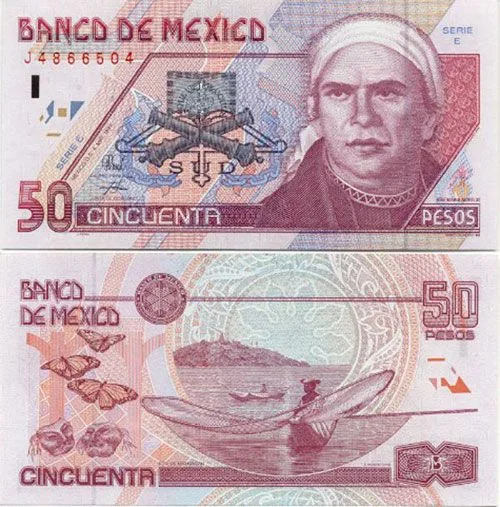
Look for: a purple polymer note with a vertical design. The front represents ancient Mexico and Tenochtitlan. The reverse has the famous axolotl among the waterways and cornfields of Xochimilco.
100-peso banknote
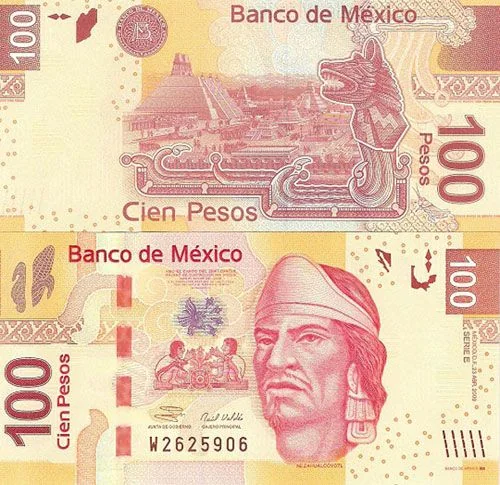
Look for: a red polymer note with a vertical design. Sor Juana Inés de la Cruz appears on the front; monarch butterflies and their forest habitat appear on the reverse.
200-peso banknote
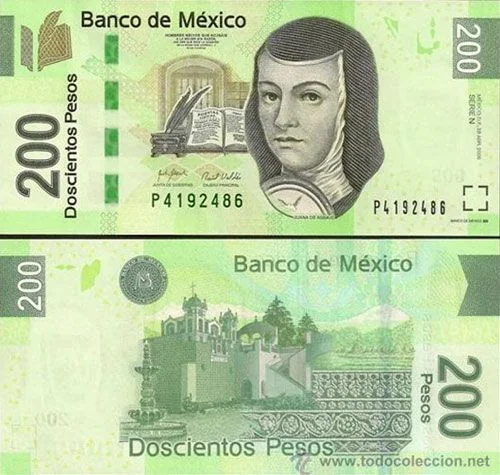
Look for: a green cotton-paper note. Miguel Hidalgo and José María Morelos appear on the front, with a golden eagle and desert landscape on the reverse.
500-peso banknote
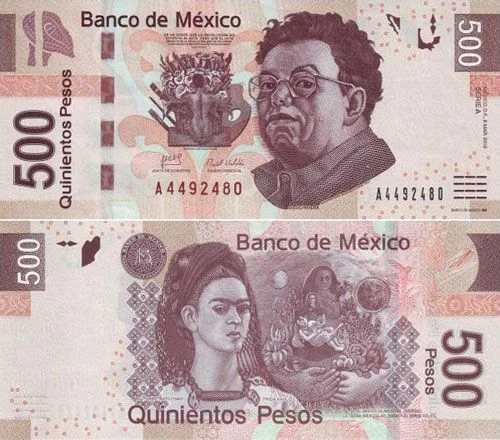
Look for: a blue cotton-paper note. Benito Juárez is on the front, while gray whales appear on the reverse.
1,000-peso banknote
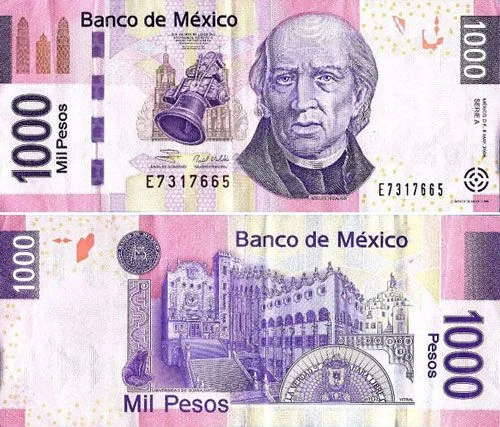
Look for: a gray cotton-paper note. Francisco I. Madero, Hermila Galindo and Carmen Serdán appear with a locomotive on the front; a jaguar and the Calakmul rainforest appear on the reverse.
The 1,000-peso note is genuine current currency, but it remains a rare find and can be awkward to spend in Cancun. Smaller shops, taxis and other outlets may not have enough change or may decline it. Try to keep smaller notes for everyday purchases.
Some 50-, 100-, 200-, 500- and 1,000-peso notes issued from August 2025 carry a temporary 100 Aniversario 1925–2025 inscription. They use the same Family G designs and remain normal currency.
Mexican peso coins
Banco de México currently lists coins of 5, 10, 20 and 50 centavos, plus 1, 2, 5, 10 and 20 pesos.
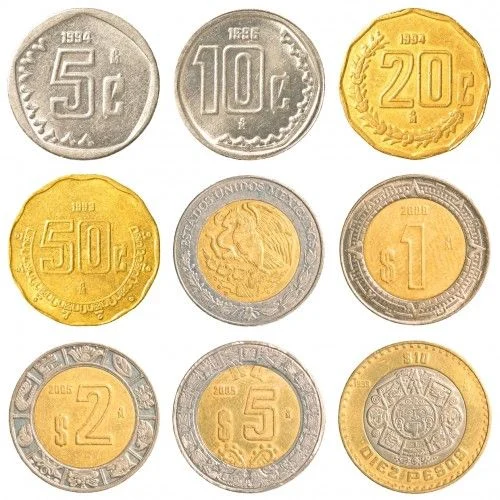
The everyday 1-, 2-, 5- and 10-peso coins are round. The 1-, 2- and 5-peso coins have a gold-colored center and silver-colored outer ring; the 10-peso coin reverses that color arrangement, with a silver-colored center and gold-colored ring. Always check the large denomination number rather than relying on color alone.
Current 20-peso coins are generally larger and 12-sided, with a gold-colored outer ring and silver-colored center. Several commemorative designs are valid, including four 2026 FIFA World Cup designs released in May 2026.
Centavo coins are legal currency, but they have little practical purchasing power. Use them when you can—even kids tend not to pick them up in the street. For current Cancun bus fares and how to pay, see Getting Around Cancun.
Older Mexican banknotes: are they still valid?
An older design is not automatically fake or worthless.
Banco de México says banknotes being withdrawn still keep the value printed on them and can still be used for transactions. When they reach a commercial bank, the bank removes them from circulation. The withdrawal list currently includes the Family F 20-, 50- and 1,000-peso notes, as well as older families.
Very old money from before Mexico’s 1993 currency change is different. On 1 January 1993, Mexico introduced a new monetary unit worth 1,000 of the old pesos—effectively removing three zeros. It was temporarily called the nuevo peso; the word nuevo was dropped in 1996.
This is why people sometimes find an old 10,000-peso note and think they are rich: its current official monetary value is 10 pesos, not 10,000 current pesos. A collector may value a particular note differently, but that is separate from its official conversion value. If you are unsure, take the note to a bank branch that provides Banco de México’s free exchange service.
How to check a Mexican banknote
Banco de México recommends a simple three-step check:
- Touch: feel the distinctive material and raised printing.
- Look: check features such as the clear window, watermark, security thread and matching details seen against the light. Features vary by denomination.
- Tilt: look for a color-changing or moving security feature.
Do not accept a note if you are seriously unsure about it. A bank can send a suspected counterfeit to Banco de México for free analysis. Do not try to pass it to somebody else; see our Cancun scams guide for the broader cash-swap warning.
What to do with a damaged peso note
Do not staple, write on or aggressively rub a peso banknote. Banco de México advises taking a damaged or incomplete peso note to a participating bank branch, where it can be assessed and exchanged if it retains its value. The service also handles withdrawn peso notes and requests for smaller denominations.
US-dollar notes are a different practical problem in Cancun. In Cancuncare’s experience, businesses commonly refuse USD notes with even small tears, writing or other visible damage, and you should not rely on a Mexican bank accepting them. Ask for an undamaged replacement immediately. If one slips through, keep it for your next trip to the United States rather than relying on spending or exchanging it in Cancun.
The practical bottom line
Use the denomination number first, then check the color, size, material and main picture. Keep a supply of 20-, 50-, 100- and 200-peso notes for ordinary spending, and avoid relying on a 1,000-peso note for a small purchase.
For exchange rates, ATMs and where to get pesos, return to the Money in Cancun hub or read Best Exchange Rate in Cancun.
Banknote and coin designs and circulation status checked against Banco de México on 12 September 2026. Because designs and withdrawal lists change, this page should be rechecked before staging implementation, before launch and during scheduled content maintenance.